



The Hatschek Machine
Operating principle, role of fibres and critical parameters in the production of asbestos-free fibre-cement sheets
1. What is a Hatschek machine?
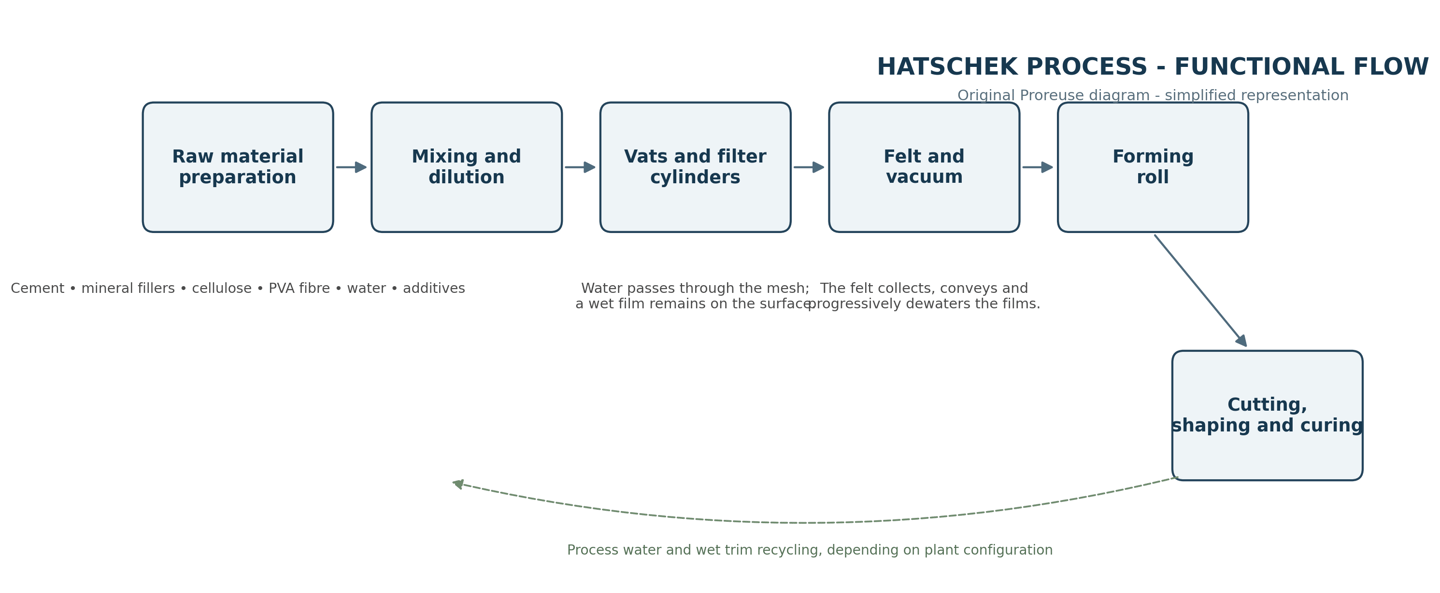
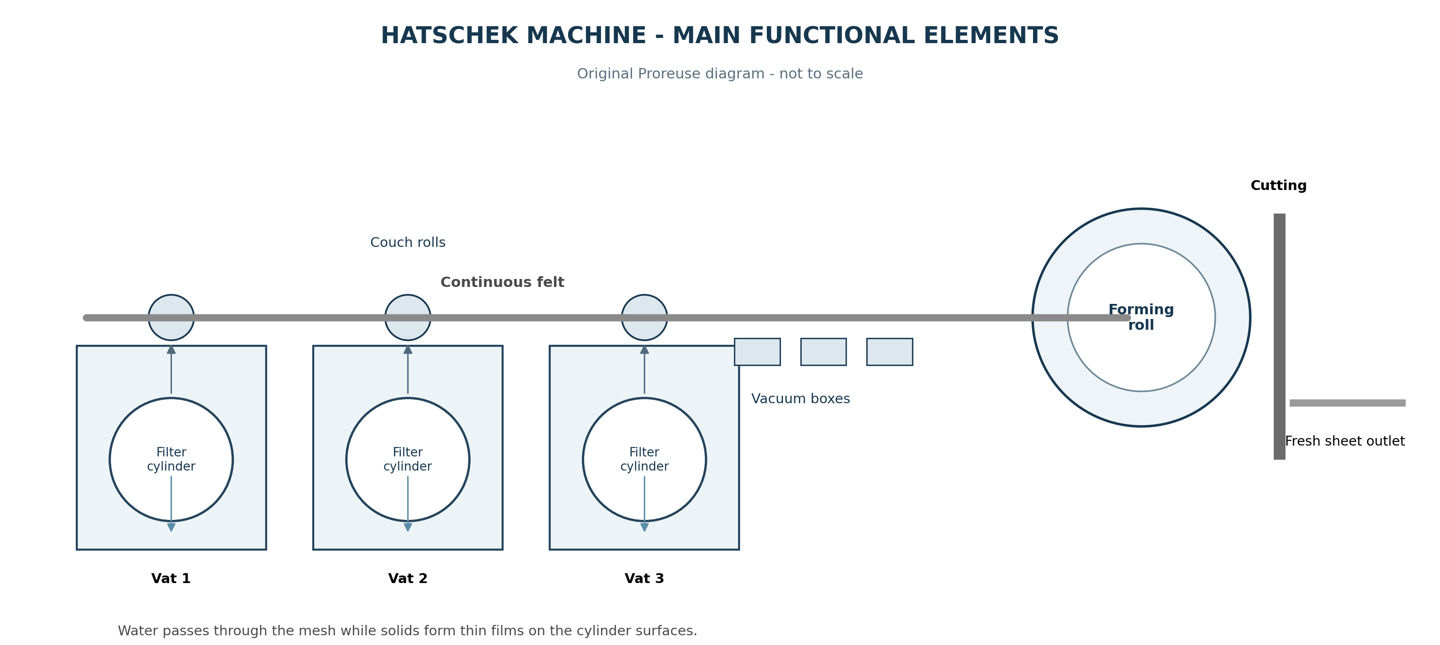
The Hatschek machine is a continuous production system used for fibre-cement sheets and profiles. Its principle is derived from filtration and paper-forming technology: a dilute aqueous suspension of cement, fillers, fibres and additives is filtered on rotating mesh-covered cylinders. The retained solids form very thin films, which are then transferred to a continuous felt and superimposed on the forming roll until the required thickness is reached [1-3].
In modern asbestos-free formulations, the system requires careful control of raw-material preparation, fibre dispersion, flocculation, drainage and contact pressures. Simply replacing asbestos with alternative fibres without adapting the formulation and the equipment may result in fibre agglomeration, loss of fines, delamination and unstable production [1].
2. Operating principle
Preparation and dispersion
Cellulose, PVA fibre and mineral components must be prepared and dispersed under controlled conditions. Cellulose usually requires suitable refining and hydration, while synthetic fibres must be distributed without producing clumps or fibre balls.
Mixing and dilution
The concentrated mix is homogenised and then diluted to the consistency required for sheet formation. The literature commonly describes very dilute slurries; a solids content in the approximate range of 7-10% is reported as a general reference, although the actual value depends on the formulation and the machine [4].
Film formation
Inside the vats, the slurry contacts rotating filter cylinders. Water passes through the mesh while a wet film of fibres, cement and mineral particles forms on the cylinder surface [1-3].
Transfer to the felt
The film is removed from the cylinder through contact with the felt and the couch roll. The felt collects the films from the different vats, combines them and conveys them without interrupting their continuity [5].
Progressive dewatering
Along the felt path, vacuum boxes and contact pressures remove additional water. Drainage must provide enough cohesion to the film without compromising transfer or interlayer bonding.
Sheet build-up
The forming roll accumulates successive films. Once the target thickness is reached, the green sheet is cut and transferred to trimming, pressing, corrugation, stacking and curing operations [1,3].
3. Role of fibres in asbestos-free technology
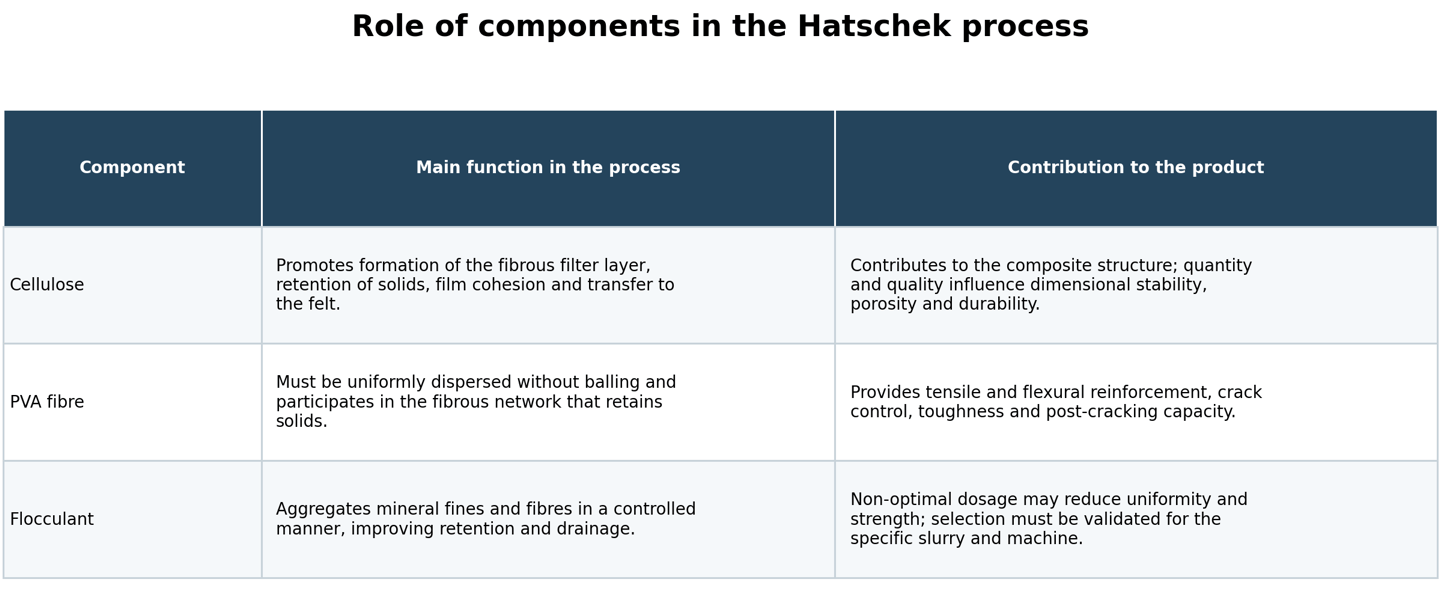
In modern fibre cement it is useful to distinguish between fibres that mainly support film formation and fibres that primarily improve the mechanical performance of the finished product. Their functions may overlap, but cellulose and PVA usually have different and complementary roles.
4. Critical process parameters
Dispersion quality
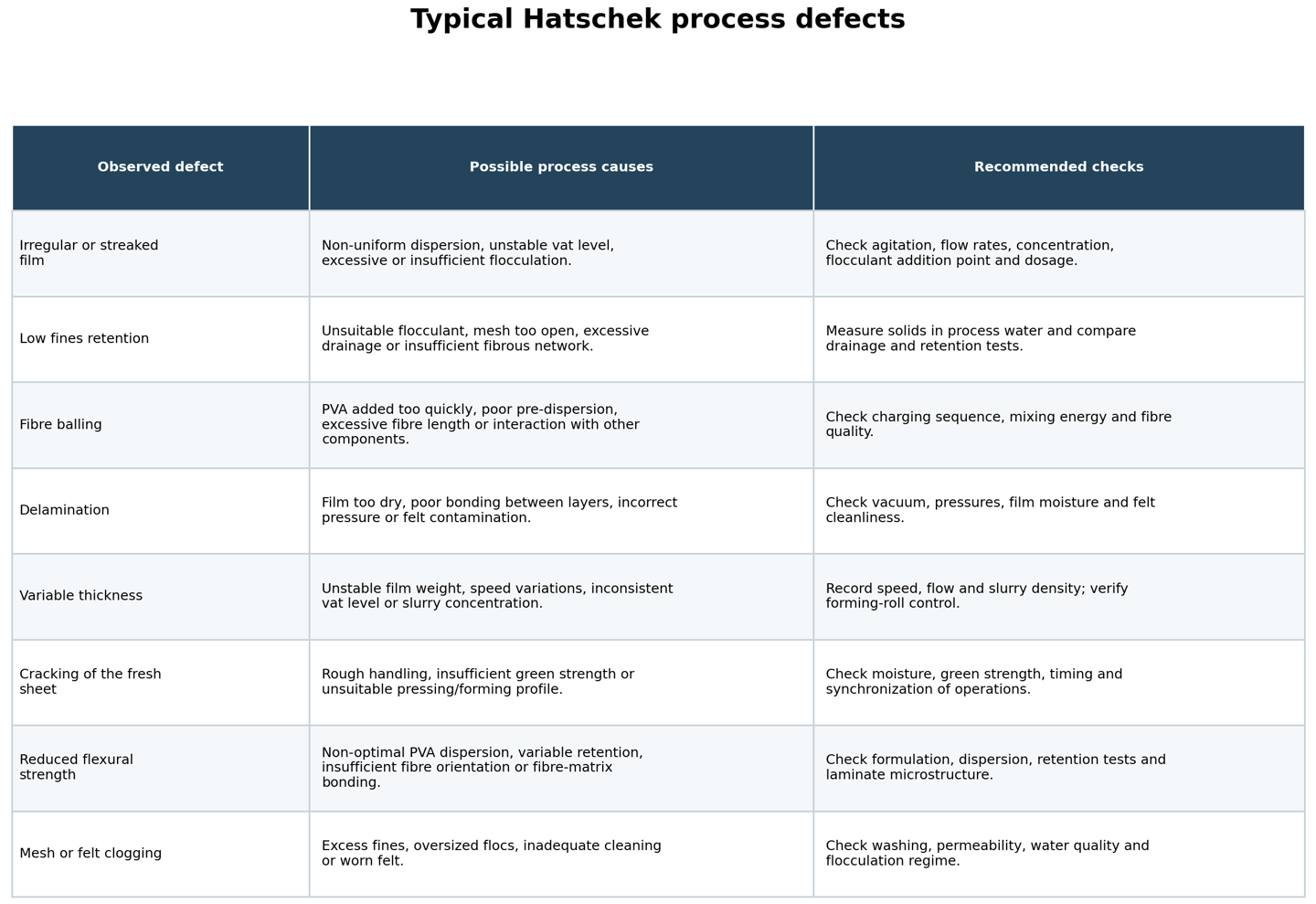
Agglomerated fibres create weak areas, surface defects and non-uniform sheet formation.
Cellulose refining
Affects drainage, retention, film cohesion and water demand. It must be matched to the pulp species and formulation.
Slurry concentration
Influences formation rate, film weight, drainage and uniformity. There is no universal value.
Flocculation
Polymer type, dosage point and amount influence fines retention, dewatering, formation and mechanical properties [6,7].
Felt and cylinder speed
Must be coordinated with flow rate, vat level, mesh permeability and drainage capacity.
Vacuum and contact pressures
Determine water content, film integrity and bonding between layers.
Felt condition
Permeability, cleanliness and wear affect film transfer, drainage and surface regularity [5].
Process-water recirculation
Closed-loop operation reduces water consumption and losses, but requires control of accumulated fines, salts and additives.
Technical sources
The information on this page has been compiled and summarised from technical publications in the fibre-cement sector. The diagrams are original Proreuse graphics and do not reproduce the figures contained in the cited sources.
[1] Do Quoc Quang; Nguyen Dinh Kien, “Hatschek Machine and Equipment for Non-Asbestos Fiber Reinforced Cement Sheets”, Proceedings of the 13th IIBCC, Aalborg, 2010.
https://www.iibcc.biz/wp-content/uploads/2019/05/IIBCC2010-Proceedings-Hatschek-machine-equipment-non-asbestos-fiber-reinforced-cement-sheets.pdf
[2] Tony Cooke, “Formation of Films on Hatschek Machines”, Building Materials and Technology Pty Ltd.
https://www.fibrecementconsulting.com/publications/011011.hatschekfilmsummary.pdf
[3] “Some Experiences During the Conversion of a Hatschek Line from Asbestos Corrugated Products Manufacturing to Non-Asbestos Technology at Navifico”, IIBCC 2014.
https://www.iibcc.biz/wp-content/uploads/2019/05/IIBCC2014-Proceedings-Some-experiences-conversion-hatschek-line-asbestos-corrugated-products-manufacturing-non-asbestos-technology-navifico.pdf
[4] A. A. Moslemi, “Technology and Market Considerations for Fiber Cement Composites”, IIBCC proceedings.
https://www.iibcc.biz/wp-content/uploads/2015/11/moslemi-technology-and-market.pdf
[5] Tony Cooke, “The Felt, Its Properties and Mode of Action in Fibre Cement Manufacture”, IIBCC 2014.
https://www.iibcc.biz/wp-content/uploads/2019/05/IIBCC2014-Proceedings-Felt-properties-mode-action-fiber-cement-manufacture.pdf
[6] A. Blanco et al., “Optimal Use of Flocculants on the Manufacture of Fibre Cement Materials by the Hatschek Process”, IIBCC 2006.
https://www.iibcc.biz/wp-content/uploads/2019/05/IIBCC2006-Proceedings-Optimal-use-flocculants-manufacture-fiber-cement-materials-Hatschek-process.pdf
[7] A. M. Cooke et al., “Selection and Performance of Flocculants for Hatschek Made Air Cured Fibre Cement”, IIBCC 2010.
https://www.iibcc.biz/wp-content/uploads/2019/05/IIBCC2010-Proceedings-Selection-performance-flocculants-Hatschek-made-air-cured-fiber-cement.pdf