
Microsilica fume
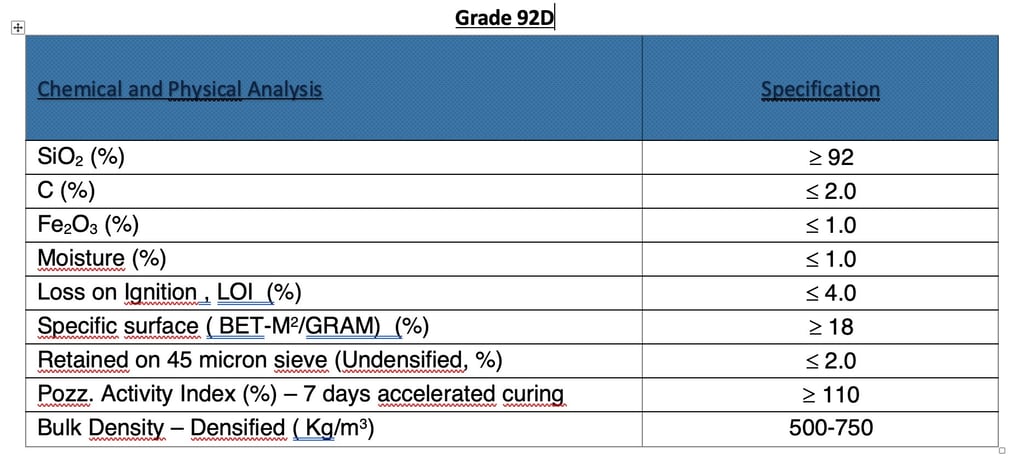
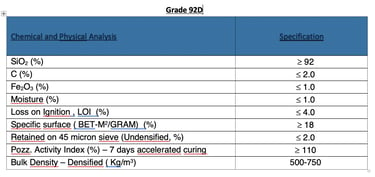
We can supply different grade of micro silica fume for cement.


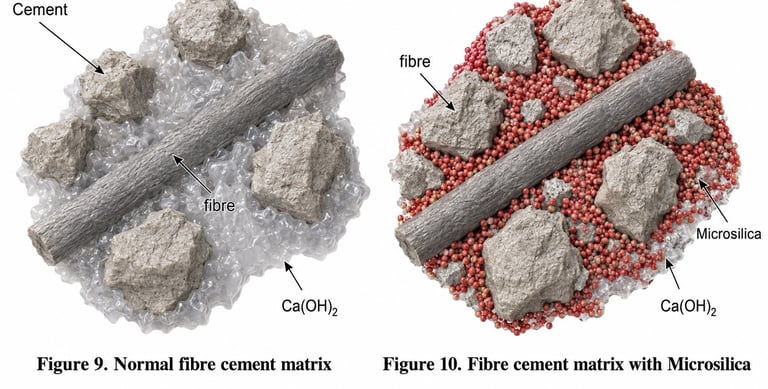
Silica fume, also known as microsilica, is an ultrafine amorphous silica used as a mineral addition in cement-based materials. In fibre-cement production it acts both as a microfiller and as a highly reactive pozzolanic material.
MECHANISM AND DISCUSSION
When cement hydrates, calcium silicate phases react with water and form calcium-silicate-hydrate (C-S-H), which is the main binding phase responsible for strength. Calcium hydroxide, Ca(OH)₂, is also produced as a secondary hydration product.
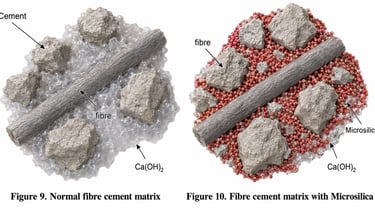
Because silica-fume particles are much finer than ordinary cement grains, they can enter small capillary spaces and voids within the matrix. This physical packing effect reduces pore size, improves particle contact and produces a denser microstructure around both the cement grains and the reinforcing fibres.
Silica fume also reacts pozzolanically with Ca(OH)₂ in the presence of water. The reaction forms additional C-S-H binder. As a result, the interfacial transition zone between the fibre and the cement matrix becomes more compact, and the number of effective bonding points increases.
The combined filler and pozzolanic effects can improve matrix cohesion, fibre anchorage and resistance to water penetration. These mechanisms are particularly useful in non-asbestos fibre-cement sheets, boards, pipes and moulded components manufactured by Hatschek, extrusion, flow-on or related processes.
MAIN USES OF SILICA FUMEunction in fibre cement
Matrix densification
Fills fine voids between cement particles and fibres, reducing capillary porosity.
Strength improvement
Supports higher early and long-term matrix strength through additional C-S-H formation.
Fibre–matrix bonding
Improves adhesion and mechanical anchorage at the interface between reinforcing fibres and cement paste.
Water-resistance enhancement
Reduces permeability and water absorption when the mixture is properly designed and cured.
Durability improvement
Can improve resistance to freeze–thaw cycles, wet–dry exposure and aggressive environments.
Process support
Can improve green-body cohesion and interlaminar bonding in sheet-forming processes, although rheology must be controlled.
PERFORMANCE BENEFITS
· Higher flexural and compressive strength of the cementitious matrix.
· Improved fibre pull-out resistance and more efficient stress transfer.
· Lower water absorption and reduced permeability.
· Denser microstructure with fewer large capillary pores.
· Potential improvement in freeze–thaw, wet–dry and heat–rain durability.
· Better interlaminar bonding in multilayer fibre-cement sheets.
· Possible reduction of efflorescence because part of the calcium hydroxide is consumed by the pozzolanic reaction.
PRACTICAL CONSIDERATIONS
Silica fume has a very high specific surface area and therefore increases water demand and mixture viscosity. Its use should be balanced with suitable water-reducing or dispersing admixtures, adequate mixing energy and careful curing. Excessive dosage or poor dispersion may cause agglomeration, loss of workability, filtration problems or non-uniform sheet formation. The optimum addition level depends on the cement, fibres, fillers, forming process and required product performance, and should be established through laboratory and production trials.
CONCLUSIONS
· Silica fume is a multifunctional additive for non-asbestos fibre-cement products.
· Its ultrafine particles improve packing and fill microvoids in the cementitious matrix.
· Its pozzolanic reaction consumes Ca(OH)₂ and forms additional C-S-H binder.
· A denser interface can improve bonding between fibres and the cement matrix.
· Correctly formulated systems may show higher strength, lower water absorption and better durability.
· Dosage, dispersion, rheology and curing must be optimized for each production process.