





Concrete
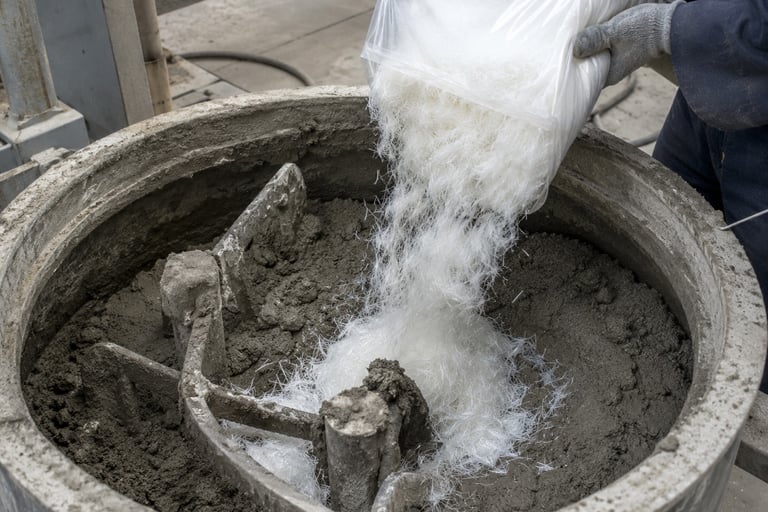
The addition of an appropriate amount of short polypropylene fibre, PPFIBER, ranging from 600 to 1,000 g per cubic metre, to concrete makes it possible to completely eliminate the risk of plastic shrinkage cracking in floors that have not been properly wet-cured.
The research also demonstrated that the mechanical properties of concrete, particularly its compressive strength, are not affected by the presence of the fibres.
The use of short PPFIBER is particularly recommended for the production of concrete intended for fire-resistant structures, such as primary linings made with sprayed concrete, or permanent linings such as those used in the production of precast tunnel segments.
Within the cementitious matrix, the fibre reduces the risk of destructive explosive spalling in the event of fire. Since polypropylene has a melting temperature of approximately 160°C, the fibres melt as the temperature rises, leaving a network of pores and microchannels. These allow the water vapour generated by the increase in temperature to release its pressure, thereby providing passive fire protection.
Mortars
Experimental studies have shown that the use of short PPFIBER, with a length of 6 or 12 mm and at an appropriate concentration in mortar:
eliminates plastic shrinkage cracking on exposed, non-formwork surfaces of cementitious materials that have not been properly wet-cured;
improves the resistance of relatively low-porosity cement mortars, with a water-to-cement ratio of 0.55, to carbon dioxide attack, even in the absence of wet curing. A low water-to-cement ratio alone does not prevent reinforcement corrosion, because inadequate or insufficient curing of exposed concrete surfaces may cause plastic shrinkage cracks;
improves the durability of cement mortars exposed to freeze-thaw cycles, provided that the mortars are air-entrained, even in the absence of wet curing. Fibre-free cement mortars, even when air-entrained, may flake or break apart along discontinuities due to the wedging effect caused by ice formation inside the cracks.
PROPERTIES
PROPERTY VALUE Polymer: 100% polypropylene
Specific gravity: 0.91 g/cm³
Fibre length: 4, 6, 12, 18 and 24 mm
Fibre diameter: 17.5 µm (±10%), corresponding to 2.2 dtex19.8 µm (±10%), corresponding to 2.8 dtex
Tensile strength: 350–450 MPa
Elastic modulus: 5–7 GPa
Finish / surface treatment: Hydrophilic
Reaction to fire: The product is not classified as “flammable” as defined in Article 2 of EEC Directive No. 67/458, but it is combustible and burns slowly
Durability: Excellent resistance to acids, alkalis and chemical agents commonly found in cementitious mixtures