





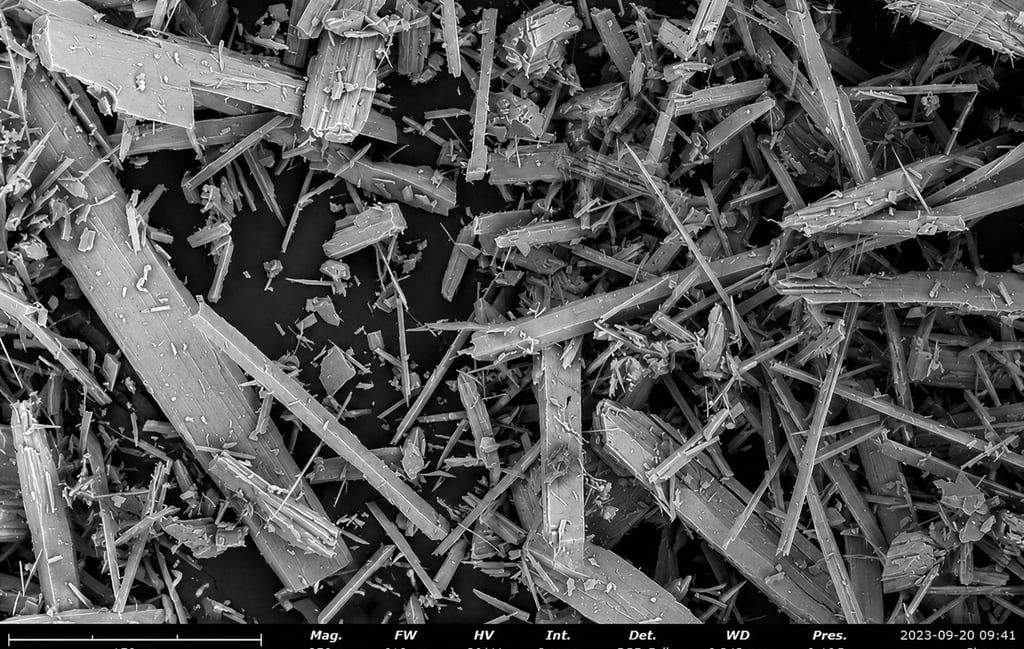
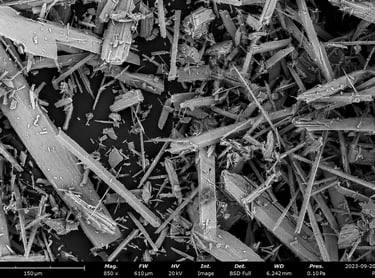
Photo wollastonite by SEM
Wollastonite is a naturally occurring calcium metasilicate (CaSiO₃), generally white and characterised by acicular, needle-shaped particles. In cement and cementitious materials, it is mainly used as a functional filler and mineral micro-reinforcement.
WHAT IT CONTRIBUTES TO THE CEMENTITIOUS MATRIX
The elongated morphology of wollastonite particles allows the material to act differently from a purely spherical or granular filler. The acicular particles can provide a micro-reinforcing effect, limiting the propagation of microcracks and improving matrix continuity.
From a physical standpoint, the powder helps fill the voids between cement particles and other fine aggregates. When the particle-size distribution is properly selected and the material is well dispersed, the resulting structure can be denser and more homogeneous.
Wollastonite is alkaline and generally stable in cementitious environments. It is not a highly reactive pozzolan like silica fume; therefore, its main contribution is physical and morphological, although the mineral surface may participate in interactions with cement hydration products.
MAIN USES IN CEMENT
Application
Expected effect
Matrix micro-reinforcement
The needle-shaped particles help counteract the formation and propagation of microcracks.
Functional filler
Fills the spaces between cement and fillers, contributing to a more uniform microstructure.
Improvement of dimensional stability
May reduce the risk of deformation and help control shrinkage in optimised formulations.
Increase in mechanical strength
May improve flexural strength, toughness and impact resistance, especially in thin or fibre-reinforced products.
Support for durability
A denser, less cracked matrix may reduce water penetration and improve weather resistance.
Special products
Suitable for fibre cement, sheets, panels, technical mortars, skim coats, cementitious adhesives, precast elements and cement-based composites.
POTENTIAL BENEFITS
· improved flexural strength and resistance to crack propagation;
· greater matrix toughness and improved impact performance;
· reduction of shrinkage microcracks when the formulation is properly balanced;
· improved dimensional and thermal stability;
· improved surface finish and greater product uniformity;
· possible reduction in permeability due to a denser matrix;
· improved internal bonding in panels and thin cementitious products.
PROPERTIES OF THE GRADE SHOWN
Parameter
Indicative specification
Calcium metasilicate (CaO + SiO₂):93.0% minimum
Brightness compared with 100% MgO:68.0 minimum
Bulk density:1.15 g/ml maximum
Moisture:0.30% maximum
Retention on 60 mesh BSS:0.60% maximum
Retention on 200 mesh BSS: 20.0% maximum
FORMULATION CONSIDERATIONS
Performance depends mainly on particle aspect ratio, particle-size distribution, dosage and dispersion quality. More acicular grades are generally preferred when a stronger reinforcing effect is required, while finer grades are suitable when filling and surface-finishing functions are the priority.